

Jump to section
- "When" means four different things
- What Instagram actually exposes
- The app treats every following list the same
- Seeing follow order for public accounts
- Sequence is not the same as a date
- Relationship scenarios: who followed who first
- Checking two accounts you don't follow
- Private accounts: hard limits
- Frequently asked questions
The short answer is: not precisely, and probably not in the way you're hoping. The follow date isn't exposed anywhere — not in the app, not through any official export or setting. What gets murky is that "when" can mean several genuinely different things depending on what you're actually trying to find out, and each has a different answer.
"When" means four different things
Most searches for this topic are really asking one of four distinct questions, and conflating them leads to a lot of frustration:
| What you might mean | Possible? | Notes |
|---|---|---|
| Exact date & time the follow happened | No | Not available anywhere — no follow date is exposed to users |
| Approximate window (recent vs. old) | Partial | Position in chronological order gives a rough sense |
| Sequence — who was followed before whom | Yes | Recoverable from public API data for public accounts |
| First detection — when you noticed the follow | Yes | Only meaningful if you have a prior baseline to compare |
This distinction matters a lot in practice. If you're trying to find out whether someone started following a specific account before or after a particular event, that's a sequence question — and sequence is something you can often work with. If you need to know the literal date, that's not publicly available through any legitimate means.
What Instagram actually exposes
Instagram's app doesn't expose follow order anywhere in its interface. The Following list on every account — your own included — is sorted by a relevance algorithm that factors in mutual connections and past interactions. There's no hover tooltip, no "followed since" label, no date column, and no sort option anywhere in the native UI.
The underlying follow sequence does exist — Instagram's public API returns following data in a consistent order that reflects when each follow happened. The app just chooses not to display it that way. For public accounts, that API-level sequence is still accessible through tools that query it directly.
The app treats every following list the same way
One thing worth clarifying: there's no special view for your own account that lets you see your follows in order. Instagram scrambles the Following list with relevance ranking regardless of whose profile you're on — your own or anyone else's. When you open your own Following list in the app, you'll see the same algorithmically sorted view you'd get looking at a stranger's profile.
The practical result is that the native app gives you no reliable way to determine follow sequence for any account. The order you see inside Instagram reflects who Instagram thinks you have a relationship with, not who was followed most recently.
Seeing follow order for public accounts
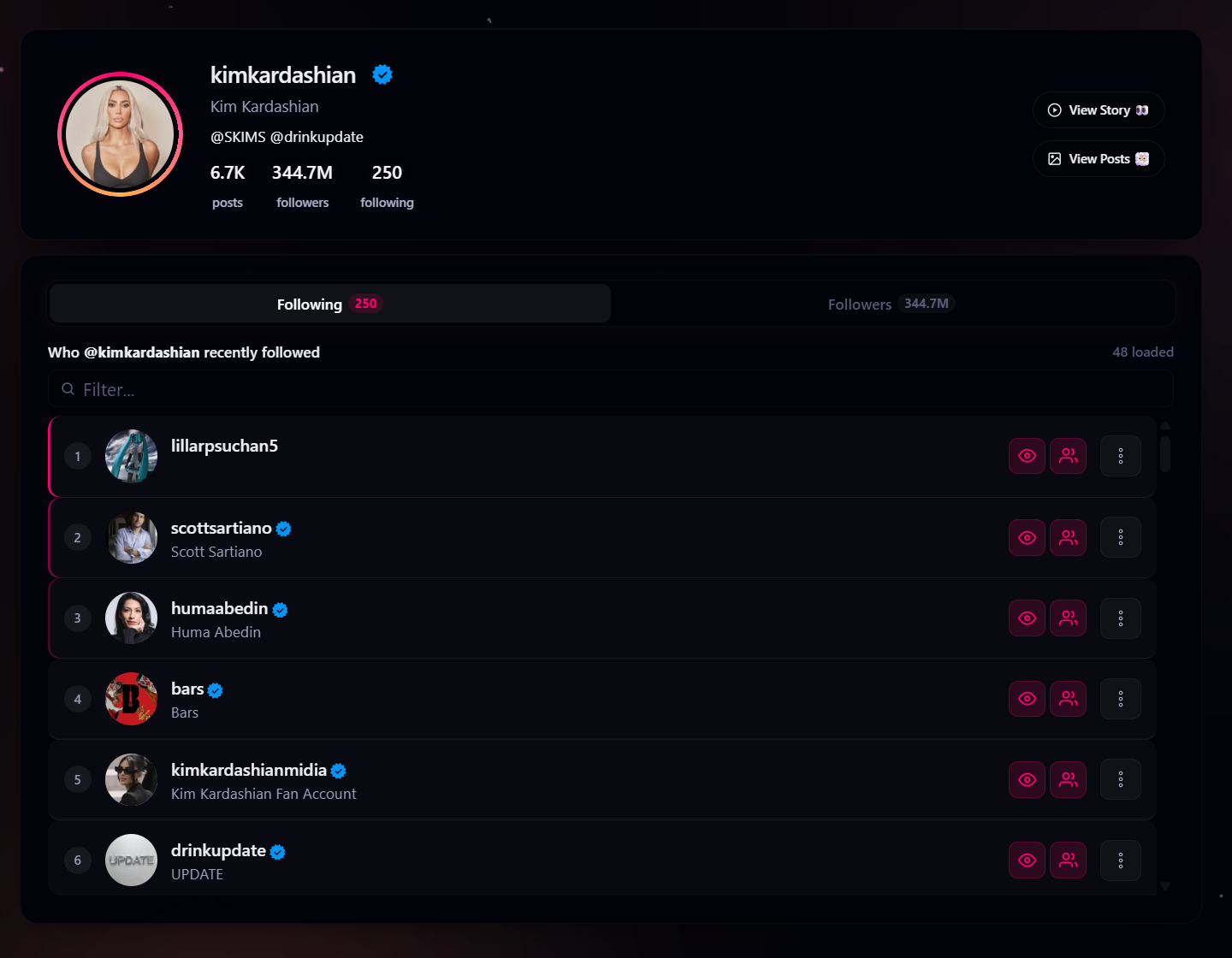
Here's where it gets more useful. Even though the app scrambles the list, Instagram's public API returns following data in a consistent order that reflects follow sequence — newest follows near the top. The native app re-sorts that data before displaying it, but the underlying sequence is still accessible for public accounts.
Tools that query the public API directly, rather than rendering the in-app view, can display that sequence in its original form. If the account you're researching sits near the top of someone's following list, that connection is recent relative to everyone else they follow; if it's buried deep in a list of thousands, it almost certainly isn't new.
InstaPeep's Recent Follower Viewer works this way for public accounts. You enter a username, and it fetches and displays the following list in the sequence the API returns — no login required, no account needed. The result tells you the order, not the date. If the account you're researching appears near the top of someone's list, they followed them recently relative to everyone else. If they're deep in a list of thousands, the connection likely isn't new.
To be clear about what this does and doesn't do: it shows you the current following list in its actual sequence. It can't tell you the date any follow happened. It can't access private accounts. And it reflects the list as it exists right now — not a historical archive of changes over time.
Sequence is not the same as a date
This is the distinction most other articles in this space gloss over, and it causes real confusion.
If you open a chronological following list today and see that Account X appears third from the top, you know Account X is among the three most recently followed accounts. You do not know when that follow happened. It could have been yesterday. It could have been four months ago — especially if the person hasn't followed anyone new since then, leaving Account X at the top by default.
Similarly, if you check a list today and notice a name you don't recognize near the top, that follow appearing now doesn't mean it happened now. It means you're seeing it now. The observation date and the event date are two different things. Without a prior baseline — a record of what the list looked like before — you can't distinguish a follow that happened last night from one that happened last spring.
The only way to catch a follow as it happens, or close to it, is regular monitoring: check the list periodically and compare. If a name appears at or near the top that wasn't there last time you looked, the follow happened somewhere in that window between checks.
Relationship scenarios: who followed who first
A common reason people search for this is a relationship question — specifically, whether a partner recently followed someone, or whether two people have been connected for a long time. These are reasonable things to want to understand, and the follow order can sometimes help, with caveats.
If both accounts are public, you can check each person's following list separately and look at where the other person appears in the sequence. If Account A shows Account B near the top of their following list, Account A followed Account B relatively recently — more recently than most of the other accounts they follow. If Account B shows Account A near the top as well, the follow was likely mutual and recent.
What this doesn't tell you: the exact date, or who followed first if both follows happened around the same time. The sequence within each list is independent — it tells you when each follow happened relative to that person's own history, not relative to a shared timestamp.
One more thing worth being direct about: if you're in a situation where you feel the need to track follow activity to understand a relationship, the list order is data. It can confirm or contradict a hypothesis. But follow sequence alone rarely tells a complete story, and it's worth knowing the limits of what you're looking at before drawing conclusions from it.
Checking two accounts you don't follow
This is the hardest version of the question. If you want to know when two entirely unrelated public accounts followed each other, you can check each one's following list and see roughly where the other person sits in their sequence. That gives you a sense of how recent the connection is within each person's history. But there's no Instagram feature — and no legitimate tool — that shows a shared follow timestamp between two accounts or tells you definitively who followed first.
What you can do: check Account A's following list and note where Account B appears. Then check Account B's following list and note where Account A appears. If both are near the top of each other's lists, the mutual follow is likely recent. If one is near the top and the other is buried, they likely didn't follow each other at the same time.
Private accounts: hard limits
Everything described above applies to public accounts only. Private account following lists aren't accessible through any external tool without the account owner's direct involvement. The sequence, the order, the list itself — none of it is available.
If you encounter a site claiming to show you private account follow history or timestamps by just entering a username, it's either fabricating data or trying to get you to complete surveys or hand over credentials. That kind of access doesn't exist through any legitimate mechanism.
For private accounts you already follow, the only option is the same manual approach that applies to any account you have access to through the app: open their following list, note what you see, and return later to compare. The app will still scramble the order by relevance rather than date, which makes this tedious — but it's the only real option.
Check Follow Order for Public Accounts
Enter any public Instagram username to see their following list in the actual sequence the API returns — newest connections at the top.
Open Follower Viewer →